
Collection Facts
Historical Context
James E. Horton was born on January 13, 1835. On October 24, 1860 he married Sarah S. Hathaway, daughter of Odell S. and Helen M. Hathaway in the home of the bride's father. Witnesses were her father Odell Hathaway, Davis H. Barclay, and Thomas C. Ring. James was employed by Hiram Falls, an importer and dealer in china, glass and earthenware. The business was located at 76 Water Street. In the 1862 Newburgh City Directory, James is now listed as the successor to Hiram Falls in this business. Horton lived at 72 Smith Street from 1864 to 1865. He made his home at 123 Montgomery Street until c. 1876. In 1867, Horton is listed as the Newburgh City Supervisor. It appears that his home was at 172 South Street from 1877 until 1878. Mr. Horton is listed as living in Goshen, Orange County, New York in the 1880 census. His occupation is listed as a Crockery Agent. Household members at that time include his wife Sarah, along with children George 15, Ida 14, Edith 11, Hiram 10, as well as a daughter Helen, age 8. In the 1900 census, James, age 65 and his wife Sarah, age 64, now married for forty years, are listed as residing in Middletown, N.Y. along with their daughter Helen M., age 28. His wife Sarah is listed in the 1910 census as 73 years of age and living in the home of her daughter Ida Tremper in Middletown.
Scope of Collection
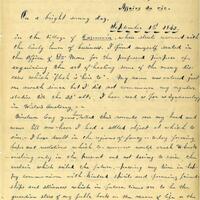
Three diaries of James Edwin Horton (1835-1903) covering day-to-day events and his employment as clerk to Hiram Falls, crockery agent in Newburgh, NY.
Browse within this collection
Browse similar collections

Collection Facts
Historical Context
Dr. James B. Preston (1926-2004) was a renowned neurophysiologist. Dr. Preston attended Ohio Wesleyan University from 1944-1945. His education was interrupted by military service. He served in Korea from 1945-1947 as a member of the Army Signal Corps and then as a medic stationed on the 38th parallel. When he returned, he attended Ohio Wesleyan for another year and then enrolled at the University of Cincinnati College of Medicine where he received his M.D. in 1952. He spent the next two years in a combined internship-research fellowship at the University of Illinois College of Medicine. In 1954 Dr. Preston was hired as an instructor at the SUNY Upstate Medical University, and in 1956 he was named an assistant professor at Upstate. In 1960 at the age of 34, he was promoted to a full professor and chairman of the Department of Physiology where he remained for 31 years before he retired in 1991. In 1992 he became a professor emeritus at the SUNY Upstate Medical University.
Dr. Preston’s scientific research centered on investigations into the neural basis of the control of movement. His contributions to neurophysiology are fundamental to our concepts of how the brain controls movement. Over the course of his career, he published over 40 research based articles in his field. His research was continuously funded by the National Institute of Health for over thirty-two years. Many of his graduate students and postdoctoral students went on to distinguished academic careers in the area of neural science. For over forty years, medical students benefited from his instruction. Preston served on numerous national and state committees including: Chairman, Physical and Molecular Biology Evaluation Conference-NIH, DRG (1968); Chairman, Physiology Training Committee-NIGMS,NIH (1971-1973); Chairman, Working Group on Pharmacology, National Advisory Committee on Multiple Sclerosis-USPHS (1973-1974); President, Association of Chairs of Departments of Physiology (1973-1974); Chairman, Subcommittee on Chemotherapeutic Agents, National Multiple Sclerosis Society (1975- 1980); Chairman, Sponsored Research Advisory Committee, Research Foundation, SUNY (1982-1986); Conference Chair, Winter Conference on Brain Research (1987-1988); Director, Winter Conference on Brain Research (1989-1991).
Scope of Collection
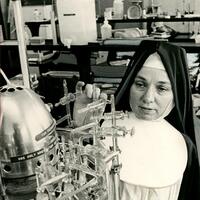
This collection contains photographs from James B. Preston, who was a Professor of Physiology at SUNY Upstate Medical University in Syracuse, NY.
Browse within this collection
Additional Information
Browse similar collections

Collection Facts
Historical Context
The collection offers access to information about life within the hospital when it operated as a tuberculosis sanitarium. The "Grit-Grin" magazine was created by the staff and patients of J. N. Adam. Content included columns documenting stories about the patients, events happening within the immediate area, and drawings and poetry. The social isolation experienced by the patients is an important context to view this material. Most of the patients came from Buffalo, NY, located 36 miles away from the rural town of Perrysburg. The social fear of tuberculosis was a barrier that kept people away. Patients were often unable to see family or friends for weeks or even years. Consequently, the staff and patients were left to create their own community. The "Grit-Grin" magazine was one venue through which this community could express itself.
Scope of Collection
The J. N. Adam Memorial Hospital collection consists of 6 copies of the magazine “Grit-Grin” published between 1928 and 1939 and 10 postcards chronicling life within the hospital. “Grit-Grin” was produced by Hospital staff and residents and offers valuable insight into this isolated community.
Browse within this collection
Browse similar collections

Collection Facts
Historical Context
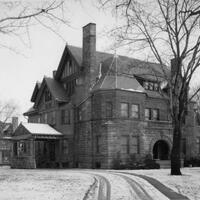
These photographs were mostly taken in 1954 by real estate appraisal company Roy Wenzlick and Company in likely preparation for the Tompkins County re-evaluation. Some appear to have been added individually in years following, up through 1968.
Scope of Collection
The collection includes black and white photographs of buildings within the city of Ithaca, New York, and shows primary street façades as they appeared in 1954.
Browse within this collection
Additional Information
Historic Ithaca
Browse similar collections

Collection Facts
Historical Context
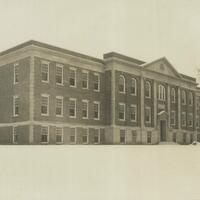
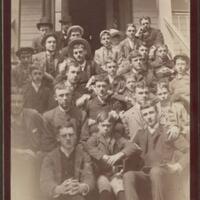
Ithaca College Yearbooks provide annual description of athletic, cultural, professional, social, and other student organizations' activities at the Ithaca Conservatory and Affiliated Schools (later Ithaca College), with many photographs of student activities and the campus, located in downtown Ithaca until the '60s. Some issues provide home-town information about all students (1926-1927, 1932-1938, 1940-1945), others provide home-town information about seniors (1981-1994, 1996-2005). Pictures of staff and faculty (individual or group) through 1979.
Scope of Collection
This collection contains college yearbooks from the Ithaca College history collections.
Browse similar collections

Collection Facts
Historical Context
C. Hadley Smith was born in Burke, NY, in 1910, the son of Mary (Hadley) and Clifford Smith. Hadley attended Clarkson University, where he studied mechanical engineering. His studies were cut short due to the Great Depression, and he found work with the Wirthmore Feed Company. In the decade that followed, he managed agricultural supply stores throughout New England. At the outset of World War II, Hadley enlisted in the U.S. Navy and served as a technical photographer, recording tests of experimental aircraft, a duty that was considered particularly hazardous. After his discharge, Hadley came to Ithaca as head of the photo lab at Agricultural Advertising and Research. In 1947, he opened his own commercial and illustrative photography business, which he and Getrude operated until 1984. Hadley's photojournalism appeared in Life, Look, Newsweek, and Time, as well as in newspapers throughout upstate New York. His advertising work was used in many national publications, particularly sports-related magazines. He photographed many notable Americans including Martin Luther King, Richard Nixon, Dwight Eisenhower, Bobby Kennedy, Linus Pauling, Carl Sagan, Mario Andretti, Wilt Chamberlain, Duke Ellington (Hadley's favorite composer and performer), Marion Anderson, Bob Hope, Mary Pickford, and Dick Gregory. Hadley was particularly proud of his long association with Ithaca College, during which he documented in photographs the growth of the college and the development of its South Hill Campus.
Scope of Collection
This is a collection of photographs which includes images of student activities and the transition and development of the Ithaca College campus from 1951 on into the 1980's. Only a portion of the collection is available online. The main collection of photographs and negatives are housed in the Ithaca College Library.
Browse within this collection
Browse similar collections

Collection Facts
Historical Context
Curated by the College Archivist, this community contains historical materials about Ithaca College and its predecessor institutions Ithaca Conservatory of Music and Ithaca Conservatory and Affiliated Schools.
Scope of Collection
This collection includes photographs, post cards, original course catalogs from the Ithaca Conservatory and its affiliated schools, and a stock certificate.
Browse within this collection
Browse similar collections

Collection Facts
Scope of Collection
This collection consists of historical photographs of people, events, buildings, and landscapes in Irvington, NY.
Browse within this collection
Browse similar collections

Collection Facts
Historical Context
The American Civil War was fought between the years 1861 - 1865 between the Union (the North half of the country) and the Confederates (the South half of the country). The war began over the disagreements between the North and South regarding slavery. The Civil War is known for having more American deaths in a war than any other war America has been a part of.
Scope of Collection
The Ingraham P. Smith Collection consists of forty-five letters and two medical documents. Smith, a resident of Middlefield, Otsego County, New York, served with the 121st New York Volunteer Infantry, Company G. The letters, written to his mother and sister, range in date from December 03, 1861 to May 06, 1865. A letter dated July 29, appears to have been written by his brother Jeremiah, who served with the 51st New York Infantry Regiment during the Civil War.
Smith’s letters describe troop movements and destinations, the capture of confederate soldiers, camp life, and information about battles, such as the Battle of Fredericksburg, Battle of Spotsylvania Courthouse and the Wilderness Campaign. His letters also furnish information about the Union hospitals and convalescent camps he was sent to when he contracted chronic diarrhea and again when he was wounded. During his recuperation Smith writes about the poor hospital conditions, death of patients, serving as a hospital guard and helping the Christian Commission and Soldiers Relief Association with an event to aid the Union soldiers. Several notable individuals such as President Abraham Lincoln, Ulysses S. Grant, George Meade, Philip Sheridan and Jefferson Davis are mentioned in Smith’s letters.
Browse within this collection
Browse similar collections

Collection Facts
Historical Context
New Hartford, New York was founded by Jedediah Sanger in the late 18th century. It’s located in Oneida County near Utica. Throughout the 19th century, New Hartford was known for its manufacturing industries, including: textiles, tanneries, and metalworks. New Hartford owes its history of industrial success to its location on Sauquoit Creek, which generated power to run the mills. The Seneca Turnpike, an early toll road, also helped the region prosper.
Scope of Collection
The Industries of Old New Hartford Collection contains photographs and postcards from the archives of the New Hartford Historical Society. This collection depicts factories of the Town of New Hartford’s initial industrial era in the late-nineteenth centuryand first half of the twentieth century. The photographs reflect the influence of the industrial revolution on the town and its surrounding area, when mills located on fast-flowing streams were built to take advantage of abundant water power. Significant aspects of workers’ lives appear in the photos; company housing, working conditions, entertainment, and strikes all find illustration. Also, the collection’s images of the American Fork and Hoe Company and the Perry & Kramer Feed Mill demonstrate New Hartford’s role as a commercial center for the many farms in the area surrounding the town.
Browse within this collection
Additional Information
Additional material regarding this subject can be accessed by visiting the society, located in the basement of the Old Point School, 2 Paris Road, New Hartford, NY 13413. Contact information, and a fascinating video that shows the society’s facilities, can be viewed on the New Hartford Historical Society's website. The society boasts an unequalled collection of New Hartford memorabilia.
Data about the photos was entered into this website by Jack Henke of the New Hartford Public Library, the Historical Society’s partner in creating this digital collection.