

Collection Facts
Scope of Collection
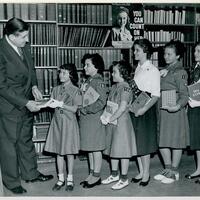
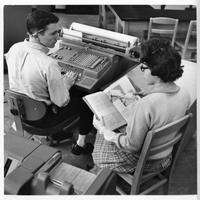
These digitized items were loaned by the Guilderland Central School District and can be viewed at the District Office at 8 School Road in Guilderland Center. Included are several syllabi from the Altamont High School (now the site of Altamont Elementary School), from the early 1900s and yearbooks from Guilderland Junior High School (now Guilderland High School) and Farnsworth Middle School.
Browse within this collection
Browse similar collections

Collection Facts
Historical Context
Grumman – For over sixty years the name Grumman had been synonymous with Naval aviation. This unique company had supplied aircraft which had consistently broken new ground both in design and performance. The Cradle of Aviation’s Grumman archives trace the development of a company that remained independent and unique for most of its history, from its founding in 1929 through the state-of-the-art jets of the late 20th century. The history of Grumman is also about the history of Long Island and the people who worked there over the course of seven decades.
Scope of Collection
Images of the Grumman Aircraft Engineering Corporation that depict its founding in 1929, to its state of the art jets of the late 20th century, its history on Long Island and the people who worked there over the course of seven decades.
Browse similar collections

Collection Facts
Historical Context
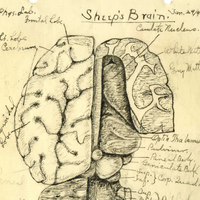
A groundbreaking ceremony for a new Health Sciences Library at SUNY Upstate Medical University took place on August 14, 1992. During the early 1990s the official name of the campus was SUNY Health Science Center at Syracuse. The proposed name for the new Library was declared to be the following; Library and Biomedical Information Resource Center. This name can be seen in the scanned documents of the collection such as: in the official program, invitation and speeches. However, a consensus developed in the succeeding years to change the name to simply, Health Sciences Library, and this is the name which continues to this day. The Library was originally designed to be over 70,000 square feet, but when it opened the actual space was about 35,000 square feet.
Scope of Collection
The collection is mainly comprised of black & white and color photographs of the Groundbreaking Ceremony, depicting speeches and interviews given by dignitaries and invited guests. Some of these speakers included, Dr. George Lundberg, editor of JAMA, Glyn Evans Assistant Vice Chancellor for Library Services, and State Senator Tarky Lombardi. Others in attendance as seen in these photographs, were many faculty and employees of the Health Science Center, and Library staff. In addition, there are documents, including the ceremony program and typed speeches.
Browse within this collection
Browse similar collections

Collection Facts
Historical Context
The Gridiron is the annual yearbook of St. Lawrence University, founded in 1856 in the town of Canton in St. Lawrence County, New York.
Scope of Collection
This collection consists of most issues of the Gridiron dating between 1880 and 2021.
Browse within this collection
Browse similar collections

Collection Facts
Scope of Collection
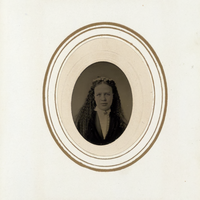
This collection contains greeting cards from the late 19th to early 20th century. It primarily includes Valentine’s Day and Thanksgiving cards.
Browse within this collection
Browse similar collections

Collection Facts
Scope of Collection
This collection includes several scrapbook volumes that tell the story of Greenwood Lake. Each scrapbook include a variety of historical materials, including newspaper articles, advertisements, photographs, and ephemera.
Browse within this collection
Browse similar collections

Collection Facts
Scope of Collection
This collection includes local obituaries clipped from newspapers.
Browse within this collection

Collection Facts
Historical Context
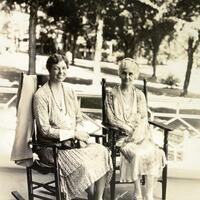
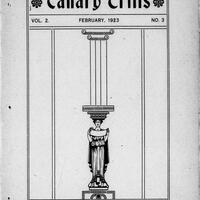
Jessie Elvira Jenks (1873 - ?). Her journals document her life from 1885-1892 between the ages of 12 and 19. Jessie jenks was born in Oneonta, New York to Willard S. and Rhoda Harris Jenks. Willard S. Jenks was a dairy farmer in Otego, New York. She was home schooled by her mother, and her home life was quiet, nonetheless she was well-read and had a well-rounded education. From 1892 - 1894 she attended the New England Conservatory in Boston. At the Conservatory she was exposed to new people and ideas, and she got to experience a metropolitan lifestyle in the city of Boston. She left the Coservatory after two years due to the financial strain on her family. She taught private classes for two years before entering the Oneonta State Normal School in 1896. Throughout her studies she remained very independent, and she frequently travelled. She was never married.
Scope of Collection
In addition to the letters and three journals Jessie kept, the collection contains teaching contracts, report cards, recommendations, resumes, newspaper clippings, and stacks of letters from 1892 to 1894 and 1930.
Browse within this collection
Browse similar collections


Collection Facts
Historical Context
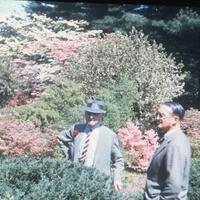
Great Neck is a region on Long Island that covers a peninsula on the North Shore of Long Island, which includes the villages of Great Neck, Great Neck Estates, Great Neck Plaza, and others, as well as an area south of the peninsula near Lake Success and the border territory of Queens. On November 18, 1643, the Hempstead Plains, which included the peninsula of Great Neck, was sold to the Reverend Robert Fordham and John Carman. In the beginning, the Mattinecock Indians and the European settlers cooperated and coexisted very well together. During the late 19th century, Great Neck was the rail head of the New York and Flushing Railroad, and began the process of converting from a farm village into a commuter town. Great Neck—in particular the Village of Kings Point—provided a backdrop to F. Scott Fitzgerald's book The Great Gatsby.
Scope of Collection
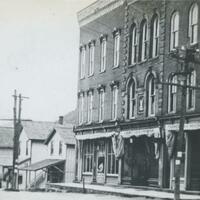
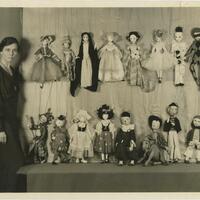
The collection consists of historic photographs of homes, light industry, roads, emergency services, parades, and people taken in Great Neck, NY in the early 20th Century.
Browse within this collection
Browse similar collections

Collection Facts
Historical Context
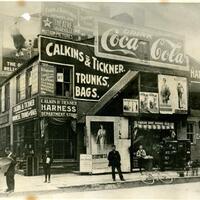
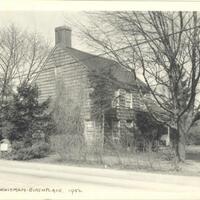
The Village of Great Neck is one of nine villages that (together with several unincorporated areas) make up Great Neck - part of the Town of North Hempstead and of Nassau County. Among Great Neck’s earliest settlements - some say the first “of any real importance and Presence” here - it is still called by many “the old village.” Like the rest of Great Neck, the Village was almost exclusively farm and orchard from its settlement in the 1660's into the 19th century. In that century, it became a small center of commerce for all of Great Neck, either selling to farmers, or servicing farmer’s needs. From 1870 to 1880, large estates were assembled. The Village experienced several real estate booms, especially after direct rail service to NYC was provided in the early parts of the century. From 1922 to 1960, the Village’s population quadrupled, and the area experienced great real estate development.
Scope of Collection
The collection consists of historic postcards depicting shore lines, commercial buildings, residences, industry, hotels, churches, lighthouses, outdoor recreation, and portraits of taken in Great Neck, NY. Additionally there are postcards showing the temporary location of the United Nations in Lake Success. The bulk of the collection is from the early 20th Century.