
Collection Facts
Historical Context
Lincoln Auditorium is located in the Central High School building in Syracuse, New York. Central High School was built in 1903 at the intersection of South Warren and Adams Street, to replace the 1867 Syracuse High School facility. Central High was designed by architect Archimedes Russell. The school has many unique architectural features, including its U-shaped design. The auditorium is located in the interior of the U-shaped building and has seating and a stage. It was originally called Assembly Hall, but was rededicated in 1903 as Lincoln Hall. Several years later the auditorium was altered to improve the acoustics by sound expert W.C. Sabine. In 1907 Lincoln Hall was reopened, with Neo-Baroque panels of acoustical plaster. The auditorium’s arch was said to be one of the largest in the United States and was adorned with a gilded eagle. In 1928 Central High was remodeled by architect Albert L. Brockway. He enlarged the assembly room to create the Lincoln Auditorium. The 1875 seat Lincoln Auditorium was used by the students at Central High, and was also used by the Syracuse community. It became Syracuse’s cultural center. Artists such as George Gershwin, Sergei Rachmaninoff and Arthur Fiedler performed at Lincoln Auditorium. The Syracuse Symphony performed in this hall for many years until the Onondaga County Civic Center was built in the mid 1970s.
The high school operated under the name Syracuse Central High School from 1903 to 1960 and later as Syracuse Central Technical High School. In 1975, the high school officially closed after the graduation of the senior class. Even though the high school has been vacant since 1975, the building is listed on the National Register of Historic Places since 1981.
Scope of Collection
Lincoln Auditorium, Central High School Programs Collection contains a collection of programs from a wide range of orchestras and artists such as musicians, singers, dancers, and actors performed at the Lincoln Auditorium in Syracuse. The collection contains programs dated from 1930-1972. A majority of the programs were collected by Nicholas C. Nett and others have been donated by various community members. Some of the programs are autographed by the performers.
Browse within this collection
Additional Information
Browse similar collections


Collection Facts
Historical Context
Lily Dale Postcards
This collection includes postcards depicting several events, activities, local individuals, buildings, and landmarks of the spiritualist community in Lily Dale, New York, made famous by the Fox Sisters. Lily Dale is a small community of psychics and mediums, and it also happens to be the oldest spiritual community in North America. Lily Dale is a site of spiritual worship where tourists can get in touch with the occult and supernatural. Today, spiritualism still thrives in Lily Dale as strongly as when it was established by the Fox sisters.
History of Spiritualism and the Fox Sisters
According to the Lily Dale Assembly, Modern Spiritualism can be defined as, "...one who believes, as the basis of his or her religion, in the continuity of life and in individual responsibility. Some, but not all, Spiritualists are Mediums and/or Healers. Spiritualists endeavor to find the truth in all things and to live their lives in accordance therewith."
Spiritualism first appeared in the 1840s in the “Burned-over District” of upstate New York and a reformed movement was started circa 1848 by the Fox Sisters—Leah, Kate, and Margaret—of Hydesville, N.Y. They reported they had made contact with the spirit of a murdered peddler and claimed that this "murdered peddler" communicated through rapping noises which were audible by onlookers. These events appealed to Americans and made the Fox Sisters an overnight sensation.
In 1888, Margaret confessed that these events and their "rappings" were a hoax and demonstrated how they did these events. She then attempted to recant her confession the following year, but their reputation had been ruined and Spiritualism continued as if the confessions of the Fox sisters had never happened.
History of Lily Dale
Lily Dale is located in the Town of Pomfret by the Cassadaga Lake in Chautauqua County, New York. Since the relocation of the Fox Cottage in 1916, Lily Dale is now the center of Modern Spiritualism with most of its population consisting of mediums and healers. Many of the operations are run by the Lily Dale Assembly. The Assembly is affiliated with the National Spiritualist Association. Today Lily Dale remains a place of pilgrimage for many Spiritualists and others interested in the paranormal because mediums and healers give readings to their visitors. Most of the landmarks within the postcards in this collection may be seen today.
These postcards were sold at Lily Dale in the early 1900s and feature scenes like picnics, gatherings, and buildings from the Lily Dale area. It is important to note that most of the postcards in this collection were made from a specific type of printing process known as Albertype. The Albertype Company is based in Brooklyn, N.Y., and was hired by a specific individual in Lily Dale only known as either "Evielena" or E.P. Bach. The Sunflower Pagoda at the Lily Dale Assembly was run by Evielena Bach, who sold books, took subscriptions to Spiritualist publications, and sold supplies such as stationery, postcards, ice cream, candy, soft drinks, novelties, and cigars. Her husband, William Bach, built the building in 1898.
The Brooklyn-based Albertype Company, owned by Herman L. Wittemann, published postcards along with other items such as souvenir books and pamphlets from around the late 1890s to the early 1950s, using a process invented by photographer Joseph Albert. Albertype was unique because it employed a collotype coating on glass plates. This processing permitted high-speed mass production of photographs for the first time. Prior to this, a copper plate was used instead of glass. Another advantage that Albertype photos have is that although the paper may yellow over time, the inks, unlike normal photographs, do not fade. The company would have photographs taken by its own agents and would also arrange to utilize photographs taken by others. Thus, Albertype postcards provide a valuable documentation of buildings and locations that may or may not exist anymore.
Additional Resources
Lily Dale Assembly
A "Dale" By Any Other Name
Scope of Collection
The collection consists of over 50 postcards representing the places and events of Lily Dale in the early 1900s. Most of the postcards are albertypes, a type of photomechanical reproduction. Many are hand-colored.
Browse within this collection
Browse similar collections

Collection Facts
Historical Context
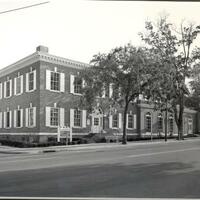
In 1950, the Saratoga Springs Public Library was chartered to serve the residents of the Saratoga Springs Enlarged City School District, and the original library building opened at the corner of Broadway and Spring Streets. That building is currently home to the Saratoga County Arts Council. The Saratoga Athenaeum, a private subscription library founded in 1885, preceded the public library.
Scope of Collection
This collection contains photographs and documents that share the history of the Saratoga Springs Public Library.
Browse within this collection
Browse similar collections

Collection Facts
Scope of Collection
This collection documents the library’s early years (1957-1969), beginning through the initiative of the Westbrook Women’s Club. The first location was at space loaned by the Guilderland Elementary School. Subsequent moves were to the laundry building next to the Wells gas station on Western Ave., the rear of the Westmere Plaza in a Central Markets space, then the front of the plaza. With increasing population growth in the town, the library moved to 1900 Western Ave, staying there for 14 years. In the years following, the library moved into rented space at 1873 Western Ave. in 1982, and then into a permanent building in 1992 after voters approved a change in status to school district public library. The library’s story through the years has been one of active and proud support by community members determined to provide the best library possible for the
Browse within this collection
Browse similar collections

Collection Facts
Scope of Collection
This collection includes several years of the Liberty High School yearbook, Libertas. Liberty High School students have been volunteering for the Liberty High School Digital Archiving Project to scan, process, and post the yearbooks. The work is labor intensive but preserves information and memories in digital format so that alumnae can access these yearbooks online.
Contact information:
Liberty High School Library
125 Buckley Street Liberty, New York 12754
Phone: 845-292-5400 ext 2017
Website
Browse within this collection
Browse similar collections

Collection Facts
Historical Context
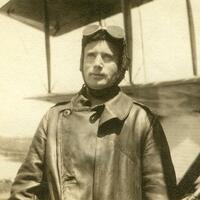
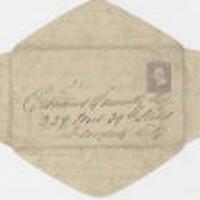
The American Civil War was fought between the years 1861 - 1865 between the Union (the North half of the country) and the Confederates (the South half of the country). The war began over the disagreements between the North and South regarding slavery. The Civil War is known for having more American deaths in a war than any other war America has been a part of. People from both halves of the nation joined this battle, both voluntarily and through a draft. Lewis Brown served in the 27th New York Regiment of the Volunteer Infantry from 1861-1863, while Burritt Brown and Al Ransom were in the 168th New York Regiment of Volunteer Infantry from 1862-1863. They all re-enlisted in the 1st New York Veteran Cavalry in 1864 and continued with this regiment until the war’s end. They were all residents of Broome County, New York.
Scope of Collection
The Lewis H. Brown Collection consists of sixty-four letters written by Lewis Henry Brown, Lewis’ brother Burritt Brown, and Albert Ransom, Burritt Brown’s friend and tent-mate. They were residents of Binghamton, Broome County, NY. The letters, written to family members, date from 1861-1863 and 1865. The letters provide insight into daily life in the camps, troop movements, and military engagements, with mention of the First Battle of Bull Run, General McDowell’s advance on Fredericksburg and the siege at Yorktown, VA. The majority of the letters were written by Lewis Brown.
Browse within this collection
Additional Information
Browse similar collections

Collection Facts
Historical Context
Levittown is a hamlet in the Town of Hempstead in Nassau County, New York. It was built between 1947 and 1951 by the real estate development firm Levitt & Sons, Inc. as a planned community for World War II veterans and their families. Levitt & Sons, Inc. was founded by Abraham Levitt in 1929. His sons, William and Alfred, served as the company's president and chief architect and planner, respectively. As one of the first mass-produced suburbs, Levittown is widely regarded as the archetype for postwar suburban communities throughout the country.
Scope of Collection
The Levittown Photograph Collection consists of photographs, photographic negatives, and photographic slides documenting the history of Levittown, New York and the daily life of its residents. The subject matter, provenance, and physical condition of the photographs varies widely. Images date from roughly 1947 to 2007.
Browse within this collection
Browse similar collections

Collection Facts
Historical Context
The Town of Middleburgh is located in Schoharie County and is one of the original towns within the county. The town was established at the end of the eighteenth century, after it survived many raids by the British during the Revolutionary War. Middleburgh grew in the area of industry and takes pride in the businesses within the town.
Scope of Collection
This collection contains photographs, news articles, and documents related to the Leonard Family of Middleburgh, New York area.
Browse within this collection
Browse similar collections

Collection Facts
Historical Context
Leo Henry Bock was born in Brooklyn, NY on September 3rd, 1880. He moved to 19 South Franklin Ave in Lynbrook, NY on March 17th, 1911 along with his wife Lillian and their two children, Walter and Marie. Bock remained a Lynbrook resident until he died on April 10th, 1973.
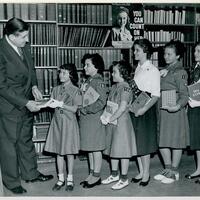
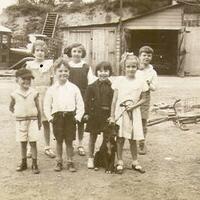
Soon after moving to Lynbrook, Bock was asked to join the Lynbrook Civic Association. At this time he was working for the Tiffany Studios as a photographer. When the Civic Association discovered his profession, he was made the official photographer of the association. During this time from roughly 1911-1917 he photographed events throughout Lynbrook and the surrounding areas. These events included a baseball game between the Lynbrook and East Rockaway Civic Associations, the 1915 Fourth of July parade and the Boy Scout rally that followed, the Lynbrook Home Defense Corps which months later turned into Company B of the 23rd regiment of the New York Guard, Memorial Day celebrations in Lynbrook in 1949, as well as his home life from 1912 into the 1940s.
Most notably, Bock photographed a Four Day Camp and Rally of the Nassau County Council of the Boy Scouts of America from August 31-September 1-3, 1917 at the Mineola Fair Grounds. The photographs from this event feature an image of President Theodore Roosevelt that is unique to this collection.
Bock closed his photography business in September 1917 due to the lack of business and frustration with the Village of Lynbrook. He was never compensated for his work. He went on to work for the art dealership P.W. French & Company and the Republican Aviation Corporation. Any photographs in the collection after 1917 were done for pleasure, past time, and occasionally the newspaper.
Scope of Collection
Approximately 240 images that capture Lynbrook and surrounding towns from 1911-1950 and three monographs of events which Bock photographed. Highlights include the Fourth of July parade in Lynbrook in 1915, Boy Scouts of America activities in Lynbrook and surrounding areas, and Lynbrook’s involvement in the Home Defense Corps and New York Guard in 1917. Most notable are the images of a four day Boy Scout rally from Labor Day weekend in 1917 in which President Theodore Roosevelt participated in and gave a speech. A large majority of these images have been scanned and are being made public for the first time as of June 2022.
Browse similar collections

Collection Facts
Historical Context
The Village of Canastota is located in Madison County, New York. It was originally inhabited by the Oneida Nation and later settled by Europeans. Captain Reuben Perkins was the original founder in 1810, and the village was formally established in 1835. After its official establishment, the village was in need of essential institutions, such as hospitals. A small hospital was opened within Canastota, but it was serving the outlying areas more than it was the village. In 1917, the the village purchased the hospital and it was named the Canastota Memorial Hospital in 1926. The hospital was remodeled in 1937, adding the following additions: improved operating room; more modern delivery room; a nursery; and an X-ray department. In 1947, the hospital struggled with financial operating losses and had trouble serving the needs of its villagers because of its inadequate physical space. The hospital was then turned over to the Town of Lenox and named the Lenox Memorial Hospital. Unfortunately, the hospital did not meet federal and state standards, making it unable to serve people who were under Medicaid and Medicare which encompassed a majority of the population. The hospital was closed in 1966 and torn down in 1969.
Scope of Collection
The Lenox Memorial Hospital Collection contains documents and newspaper clippings about the hospital that served the area in the early to mid-twentieth century.