
Collection Facts
Historical Context
The Newburgh Glebe was established in 1719 by immigrants from the German Palatinate of the Rhine. Each family was given 100-300 acres and a central plot for support of a Lutheran minister. The first patent of the Glebe, then known as the German patent or Palatine Parish, was surrendered in 1752 after the arrival of Dutch and English settlers. The second patent was established and was then known as the Parish of Newburgh and the clergyman was replaced by a minister of the Church of England. In 1794, it changed again when Presbyterians were elected Trustees of the Glebe.
Scope of Collection
The Newburgh Free Library's Glebe Documents Collection provides an extensive record of the Glebe's activities from the 1790s through the early 1900s. These online documents represent only a selection of the Glebe materials that are held in the Newburgh Free Library's Local History Collection. Please contact the Local History Librarian at the library for more information.
Browse within this collection
Browse similar collections

Collection Facts
Scope of Collection
This collection includes a variety of historic documents, photographs, postcards, booklets, and flyers, from the library's Local History Collection.
Browse within this collection
Browse similar collections

Collection Facts
Scope of Collection
The City of Newburgh embarked on a new assessment of its properties in 1916 as the community was growing. This collection of old sepia photographs are all that can be found extant of what was likely a more extensive inventory. Views of the city that year capture Newburgh just before one of its biggest growth spurts during the First World War when over 3,ooo new residents arrived to work in factories and shipyards retooled for the war effort.
Browse within this collection
Browse similar collections

Collection Facts
Historical Context
At the dawn of the 20th century, automobiles were an infant technology with none of the infrastructure we take for granted today: road maps, traffic signals, paved roads, gas stations, fast food, parking lots, expressways, or motels. Most people in the world had not yet seen a car in person.
What, then, could be more fun than the first 'round-the-world automobile race under such punishing conditions? In the summer of 1907, Paris newspaper Le Matin and the New York Times announced The Great Race: New York to Paris by Automobile.
Four nations entered six cars: Italy, with the Brixia Zust; Germany, with the Protos; France, with the De Dion, the Moto-Bloc, and the Sizaire-Naudin; and the United States, with the Thomas Speedway Flyer.
Legend has it that the Thomas Flyer entered the race at the insistence of President Theodore Roosevelt, who hated the prospect of European automobiles crossing the country unchallenged by Americans.
Better-established companies, such as Buffalo’s Pierce-Arrow, declined to enter. But the Thomas Automobile Company, also from Buffalo, pulled one if its production models out of its factory at the last minute and entered the race. Buffalo’s own George Schuster was driver and chief mechanic.
The starting line, on February 12, 1908, was in Times Square. Two hundred and fifty thousand people turned out to watch. The route crossed the country to San Francisco. There, drivers shipped out to Alaska and drove to the Bering Strait, where they ferried across and pushed through Russia to Europe, finishing at the Eiffel Tower. Organizers estimated the trip to take six months and the route to be 20,000 miles long.
Newspapers around the world followed the progress of the race. The Sizaire-Naudin didn’t get past the snowdrifts of the Hudson Valley before dropping out. The Moto-Bloc got lost in the farmfields of Iowa and withdrew. The Protos was caught cheating when the driver boarded it on a train and received a 30-day penalty. Fearing bandits and the brutal weather of Siberia, the De Dion backed out in Russia.
The Protos crossed the finish line first, but factoring in its penalty, did not win the race. The Thomas Flyer arrived in Paris on Friday, July 31, 1908, 170 days after leaving Times Square, the true winner. Buffalo was ecstatic and threw George Schuster a hero’s welcome party in Cazenovia Park that drew 10,000 people.
The victory of the Thomas Flyer briefly boosted sales for the Thomas Automobile Company, but mechanical flaws in subsequent models doomed the company, and all production ceased in 1913. Its factory at 1200 Niagara Street is presently used by Rich Products and bears a plaque honoring its achievements.
The winning Thomas Flyer was restored to finish-line condition under supervision of George Schuster, who died in Springville in 1972 at age 99. It is on exhibit at the National Automobile Museum in Nevada. Hollywood fictionalized the New York-Paris race in the 1965 movie, The Great Race, starring Jack Lemmon, Peter Falk, Tony Curtis, and Natalie Wood.
Additional Resources
Thomas Flyer in Ames, Iowa (Ames Historical Society)
The Great Auto Race of 1908
Great Race of 1908: Competitors (New York Times)
The Greatest Auto Race On Earth
Scope of Collection
The collection includes a 1905 Thomas Flyer catalog and detailed map of the 1908 New York to Paris race route.
Browse within this collection
Browse similar collections

Collection Facts
Historical Context
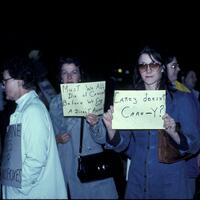
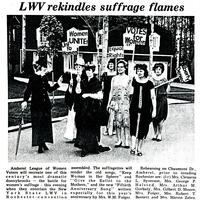
The resolution calling for woman suffrage had passed, after much debate, at the Seneca Falls Convention in 1848, convened by Elizabeth Cady Stanton and Lucretia Mott. In The Declaration of Sentiments, a document based upon the Declaration of Independence, the numerous demands of these early activists were conveyed. The 1848 convention had challenged America to social revolution that would touch every aspect of life. Early women’s rights leaders believed suffrage to be the most effective means to change an unjust system. By the late 1800s, nearly 50 years of progress afforded women advancement in property rights, employment and educational opportunities, divorce and child custody laws, and increased social freedoms. The early 1900s saw a successful push for the vote through a coalition of suffragists, temperance groups, reform-minded politicians, and women’s social-welfare organizations. Women won the right to vote in New York State in 1917, and in the rest of the country with the passage of the 19th amendment in 1920.
Scope of Collection
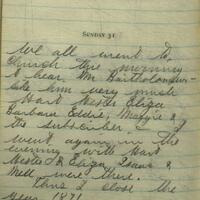
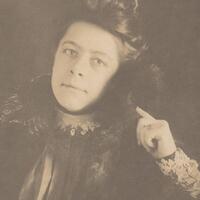
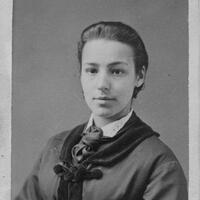
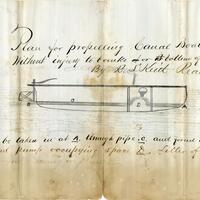
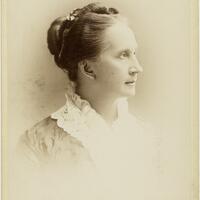
This digital collection includes items related to women's suffrage in various formats, including advertisements, greeting cards, photographs, ephemera, maps, and articles, dated from 1848-1919. Most of these items were gathered together digitally for use in the online exhibit, "Recognizing Women's Right to Vote in New York State." The physical representations of these items are spread across many collections. The South Central Regional Library Council does not own any of the original items in this collection.
Browse within this collection
Browse similar collections

Collection Facts
Historical Context
Grant W. Johnson of Ticonderoga served as Essex County's lone State Assemblyman from 1953 until his death in 1965. In that time, New York's roads were of particular interest to him, especially the proposed "Adirondack Northway," an extension of the State Thruway's I-87 segment, that would link Albany to the Canadian border. While most "North Country" residents, and many others in the Empire State, favored the highway, considerable debate accompanied the path it would take between the town of Glens Falls and Plattsburgh. Communities in the Champlain Valley, including Johnson's native Ticonderoga, predictably favored an eastern path roughly paralleling NYS Route 22.
Others, especially the NYS Department of Public Works, supported one to the west alongside US Route 9. Governors W. Averell Harriman and Nelson A. Rockefeller, as well as Assemblyman Johnson, sided with the DPW's proposed route. One hurdle to be cleared, however, was the State Constitution's Article XIV's "Forever Wild" clause, inserted protecting New York's Forest Preserve. While only 400 acres would be affected by the new highway, an amendment was required. A statewide referendum passed in 1959, clearing the way for construction of the Northway.
Scope of Collection
This collection documents Johnson's role, and that of others, from Governor Thomas E. Dewey's proposal for a major highway to connect New York City and Montreal in 1953 to the 1960 aftermath of the referendum results. Researchers interested in the early implementation of the National Interstate and Defense Highways Act of 1956, the Adirondack Park, or state & local politics of the era will find much of value in this collection.
Browse within this collection
Browse similar collections

Collection Facts
Historical Context
On December 11, 1941, Germany declared war on the United States. Three months later, 250 families living between the Oswego and Seneca Rivers, on and round the Radisson site, were ordered by the Army Corps of Engineers to evacuate their homes. Eight thousand acres of land were depopulated by the orders, and all roads into the area were blocked. Within a month, construction of a huge ordnance plant began, with more than 3,000 workers employed at the peak of construction. By January 1943, less than a year later, the plant was in operation. The plant was under heavy security. Ten miles of chain link fencing with strategically located guard towers protected it. At night, floodlights played on all perimeter areas. Inside were 88 main buildings and more than 20 miles of roads. Eight thousand men and women worked there. They made, processed and shipped dinitrochlorabenzene, more familiarly known as “Explosive D.” It was used in armor piercing shells, and it and its processing were deadly business.
“Explosive D” was made, basically, from a peaceful enough coal tar derivative used for dye making. But, by the time the Works got through treating it with nitric and sulphuric acids, boiling it and cooling it and, finally, shipping it, it was anything but peaceful. It was stored in concrete magazines located generally in the area of what is now the Game Management Preserve, along Sixty Road.
The most dangerous operations were conducted in buildings along the east side of Radisson’s drumlin. This was done so that, in the event of an explosion, Baldwinsville would be shielded from danger. The concrete foundations along the east side of the drumlin, off Willett Parkway, were part of that main manufacturing area. They supported acid vats used in processing the explosive. The architectural sculpture that identifies Radisson’s main entrance at Route 31 was conceived in 1974 by Sergi Yevich of Baldwinsville who was an architect and planner for Radisson. He used the shape of the cradles that supported those vats as the basis for his design. The actual cradles were half the size of those in the finished sculpture. There were five of these areas along the face of the drumlin.
A year and two months after production began, it was stopped. Following the War, the property was declared surplus, and the Works were abandoned. The next few years, as the Works were dismantled or destroyed and the property disposed of, were active ones. Only the administration buildings near Rt. 31 and some of the larger concrete buildings remained.
Some farmhouses and cottages left from before the War were offered to the public for lease. A plan to use the larger buildings for veteran’ housing fell through. Over 5600 acres went into the land bank and was eventually sold. State officials looked into the possibility of relocating the State Fair there but then decided not to. Syracuse University began renovating some of the buildings for student housing, but the work was never completed.
The State Conservation Department purchased 3000 acres in the north end of the property from the Game Management Preserve. Later, in 1952, the trustees of the William Waldorf Astor estate bought 2000 acres for residential and commercial development. This never took place. For the next 20 years, the land stood idle.
In 1969, the Urban Development Corporation (UDC) purchased the site and in 1971 they began developing a Planned New Community. It is now called Radisson, The name being derived from a mid-17th Century French explorer of the Syracuse area, Pierre Esprit Radisson, who was also a co-founder of the Hudson Bay Company.
Scope of Collection
The New York Ordnance Works Collection consists of photographs, maps, and official documents related to the New York Ordnance Works (NYOW).
Browse similar collections

Collection Facts
Historical Context
The mission of the Northeast College of Health Sciences museum is to gather and preserve artifacts relating to the history and cultural heritage of the programs offered at Northeast College of Health Sciences, and to expand the understanding of natural healthcare to the College community and world at large. Through collections and exhibits both physical and electronic, the museum strives to reflect the past, present and future of natural healthcare at Northeast College of Health Sciences.
Scope of Collection
A small collection of art and decorative works including paintings, posters, architectural drawings, and sculpture.
Browse within this collection
Browse similar collections

Collection Facts
Historical Context
Buffalo was a main hub of transportation in the early 20th century and had many railway stops. The New York Central Railroad decided to build a central station in Buffalo to relieve the congestion from the smaller city stations. The Buffalo Central Terminal was completed in 1929 with a distinctive art deco architecture style. With the popularity of automobiles and population decline in the region, the Central Terminal closed in 1979. It is currently owned by a non-profit preservation group.
Scope of Collection
This Buffalo & Erie County Public Library scrapbook contains mounted, local, newspaper clippings about the Central Railroad Terminal in Buffalo, New York, from 1929-1931. The Terminal opened on June 22, 1929.
Browse within this collection
Browse similar collections

Collection Facts
Historical Context
New-York Central College, McGrawville was an institution of higher learning founded by Cyrus Pitt Grosvenor and other anti-slavery Baptists in 1849 in McGraw, New York. The college was notable because it educated blacks as well as whites in the time of southern slavery and northern segregation, and educated women with men at a time when few institutions of higher learning were co-educational. In addition to the African-Americans in the student body, at least two of the school's faculty were also black. The school's curriculum included classical education as well as agricultural science.
Scope of Collection
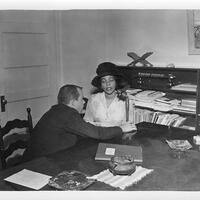
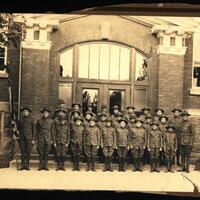
This is a collection contains photographs of the classroom buildings, along with students and professors who attended the college. Also included are paper clippings, speeches, and notes about the New York Central College historical marker dedicated in 1985 where the school formerly stood.