
Collection Facts
Scope of Collection
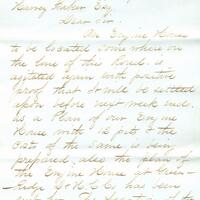
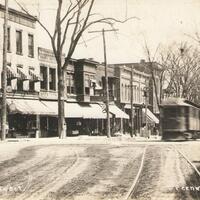
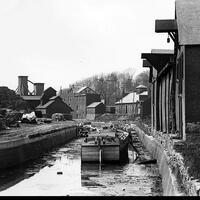
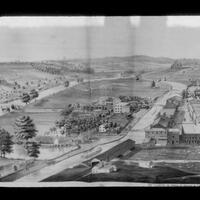
This collection includes images and documents related to the Maybrook switching terminal and the railroads it served. It contains photographs of the switching station, railroad tracks, and staff, as well as aerial photos of the terminal yards. The collection also has historic documents such as schedules, maps, and some governing documents.
Browse within this collection
Browse similar collections


Collection Facts
Historical Context
The celebrated theater director Max Reinhardt, recognized in America primarily for his elaborate productions of Shakespeare’s A Midsummer Night’s Dream, Franz Werfel’s The Eternal Road, and Karl Vollmoeller’s The Miracle, was born in 1873 at Baden near Vienna, Austria and died in New York City in 1943. Reinhardt’s illustrious career takes on added significance because it coincides with a major shift in the evolution of the modern theater: the ascendancy of the director as the key figure in theatrical production. Reinhardt’s reputation in international theater history is secured by the leading role he played in this transformation, as well as by his innovative use of new theater technology and endless experimentation with theater spaces and locales, which together redefined traditional relationships between actor and audience toward a new participatory theater.
Scope of Collection
The Max Reinhardt Library and Archives at Binghamton University is one of several notable collections worldwide of books and manuscripts dealing with the work of the Austro-German theatre director Max Reinhardt (1873-1943) and the largest such collection in North and South America. It contains approximately 15,000 books from Reinhardt’s personal library and over 10,000 manuscripts, items of correspondence, photographs, programs, critical reviews, directorial promptbooks, writings, and related supporting materials totaling approximately 100 cubic feet. This collection, which covers major but not all aspects of Reinhardt’s life and theater work, may be termed selective rather than comprehensive in nature, with particular strengths at three discrete stages in Reinhardt’s career: Imperial Berlin (1900-18), Salzburg Festival (1920s-30s), and work undertaken in the United States both before and after Reinhardt’s emigration there in 1937. The bulk of the Collection was acquired in the 1960s from son Gottfried Reinhardt, with a major later addition by widow Helene Thimig-Reinhardt, as well as subsequent incremental donations from family members and former theatre associates.
Browse within this collection
Additional Information
Binghamton University
Browse similar collections

Collection Facts
Historical Context
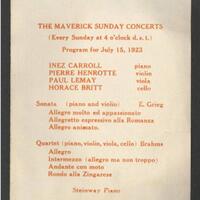
The Maverick Art Colony was founded in 1905 by by Harvard graduate turned social activist, author, idealist and bohemian, Hervey White. Music was a crucial part of the colony, and it drew many musicians and artists over the years. In 1916, Hervey began hosting a chamber music concert series featuring both amateur and acclaimed musicians. This series, called The Maverick Sunday Concerts, continue to this day.
Scope of Collection
This collection includes programs from the long-running Maverick Sunday Concert Series, held in Woodstock, N.Y.
Browse within this collection
Browse similar collections


Collection Facts
Historical Context
The Maverick Art Colony was founded in 1905 by by Harvard graduate turned social activist, author, idealist and bohemian, Hervey White. Music was a crucial part of the colony, and it drew many musicians and artists over the years. In 1916, Hervey began hosting chamber music concerts featuring both amateur and acclaimed musicians. These concerts continue to be held to this day.
When asked about performing at The Maverick, musician and founding music director of the National Orchestral Association Leon Barzin noted that, "From the very beginning, music at the Maverick was a unique effort of professionals and amateurs”. He also stated that, “from the very first performance there was a delightful mixture of formality and informality. Nothing in Woodstock can ever be completely formal." Barzin was just one member of a diverse gathering of musicians who played in the concerts. Prominent performers also included Pierre Henrotte, concert-master of the Metropolitan Opera House, George Barrere, internationally renowned flutist and Boris Koutzen, gifted composer and member of the first violin section of the Philadelphia Orchestra.
Scope of Collection
This collection includes photographic portraits of musicians who played in concerts held at The Maverick in Woodstock, N.Y. Many of the images are signed by the musicians.
Browse within this collection
Browse similar collections


Collection Facts
Historical Context
The Maverick Art Colony was founded in 1905 by by Harvard graduate turned social activist, author, idealist and bohemian, Hervey White, when he and Fritz van der Loo purchased a farm in the Hutley Patentee Woods. Hervey envisioned the farm becoming a new art colony, where the old restrictions on individual freedoms would be put aside. Hervey's creed for the Maverick colony was simply put, "Do what you want to (as long as you don't harm others)."
The short geographic distance between Greenwich Village in New York City and Woodstock in upstate New York, brought artists, musicians, social reformers and intellectuals to Woodstock. Life quickly became more unconventional and bohemian, as viewed by the more conventional Woodstockers. Feelings of unfriendliness between the locals and the newcomers intensified. Hervey believed that he could placate the local residents by providing musical performances, and at first, chamber music was performed for a small fee in Woodstock's Fireman's Hall. The audiences grew rapidly and it became apparent that people were willing to pay to hear the well played classical chamber music. Hervey began to look for a suitable concert hall, hoping it could be found at his Maverick farm.
By 1915, summer residencies at the Maverick Art Colony increased to more than twenty-five cabins, and so did the need for water and creature comforts. After having a well drilled an astonishing five-hundred and fifty feet deep, Hervey was faced with a bill for fifteen hundred dollars, far more than he expected. Plans to raise money for paying this bill turned into the organization of the first Maverick Festival.
Using available resources, Hervey and friends converted a stone quarry on the Maverick property into an open-air theater. Seating, a stage and an orchestra pit were built and picnic grounds are where the present Maverick Concert Hall stands and the long running Maverick Summer Concert Series performances are still held today. Hervey viewed the Maverick Festivals as an opportunity for all people, whether involved in the arts or not, to share in the festival pageantry, wearing fantastic costumes, picnicking around campfires, and enjoying numerous performances.
Scope of Collection
This collection features photographs and ephemera from the 1920s Maverick Festivals.
Browse within this collection
Browse similar collections


Collection Facts
Historical Context
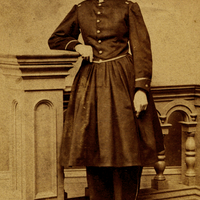
Maurice Leyden was born 1836 in Collamer, Onondaga County. He attended Cazenovia [New York] Seminary and high school in Syracuse, New York. He obtained his dental education under the tutelage of Dr. Amos Westcott. At the outbreak of the Civil War, Leyden enlisted in the 3rd New York Cavalry, rising to the rank of Captain. In 1865 he was transferred to the Fourth Provisional Cavalry and mustered out in 1869.
After his military service ended Leyden opened a dental practice in Rochester, Monroe County, New York. Here he resided with his wife Margaret, a Rochester native, and his two daughters, Maude, who died in infancy, and Blanche.
Scope of Collection
The diaries document mid-nineteenth and early twentieth century life in Rochester, Monroe County, New York. Leyden writes of day-to-day life with entries about the weather, family life and activities, his dental practice and business travel. Leyden, a member of the Republican Party, writes of his involvement in local politics. The financial accounts of family and business expenses provide additional insight into the cost of living at this time.
Of particular interest are entries concerning the Women’s Suffrage movement. Leyden and his wife, Margaret were supporters of the movement and friends with Susan B. Anthony. The diaries contain entries of attending lectures by Susan B. Anthony and Elizabeth Cady Stanton, as well as other notable suffrage speakers. Leyden provides details of his wife Margaret’s involvement in the movement. Leyden writes of Margaret’s arrest along with several other women, including Susan B. Anthony for registering to vote in 1872, and Anthony’s subsequent trial for refusing to pay the fine imposed up her for the illegal registration.
Browse within this collection
Additional Information
Browse similar collections

Collection Facts
Historical Context
Maureen Paula O'Sullivan (17 May 1911 – 23 June 1998) was an Irish-American actress. She was married to the director John Farrow and had seven children with him (one of whom was actress Mia Farrow). After being widowed for twenty years, O’Sullivan was married to her second husband, James Cushing, a Niskayuna, NY businessman, from August 22, 1983 until her death in 1998.
Scope of Collection
Mr. Cushing was a member of the board of trustees for Maria College, Albany, NY. This collection represents personal correspondence written by O’Sullivan to Sister Laureen Fitzgerald, former President of Maria College, as well as the wedding announcement and photographs of O’Sullivan and Cushing related to Maria College events.
Browse within this collection
Browse similar collections

Collection Facts
Historical Context
From 1986 to 1987 the Adirondack Museum commissioned Mathias Oppersdorff to photograph a selection of Adirondack residents. About 75 people in the Adirondack Park and the surrounding region were photographed in their familiar environments showcasing them at home, work, and outside doing various activities. This assignment resulted in a 1989 traveling exhibition sponsored by the Museum titled Adirondack Faces, and a 1991 publication of the same title.
Scope of Collection
The collection of black-and-white photographs consists of portraits of Adirondack residents taken in personal settings, such as gardens or homes. Also included in the collection are the contact sheet prints, The collection dates to the mid-1980s.
Browse within this collection
Browse similar collections


Collection Facts
Scope of Collection
This collection relates to the opening of the Memorial Art Gallery on October 8, 1913. The documents include: a Memorial Art Gallery membership brochure, invitations to the dedication of the Gallery and opening exhibition, a catalog of the Inaugural Exhibition, a membership card to the Gallery, and correspondence relating to the Inaugural Exhibition.
Browse within this collection
Browse similar collections

Collection Facts
Historical Context
Masten Park High School was the second public high school in Buffalo, New York. It opened in 1897 on the East Side of Buffalo in the Masten Park neighborhood. By 1900, MPHS had enrolled over 1,100 students, as the population of Buffalo soared. A fire during the school day on March 27, 1912, which almost completely destroyed the building. At great cost, the school was rebuilt and reopened in 1914. The building is renowned for its architectural influences, and is now on the National Register of Historic Places. The yearbooks chronicle the students, staff and faculty of the school, and its famous Principal Dr. Frank Sheldon “Fearless” Fosdick. The building served as home to three more Buffalo Public Schools: Fosdick-Masten High School, Girls Vocational High School, and City Honors School.
Scope of Collection
The Masten Park High School Chronicles are paper-bound, semi-quarterly publications of Masten Park High School in Buffalo, New York. Four to six issues per year, 1900-1927, featured literary and journalistic writing of students, photos of sports teams and activities, advertisements for local business in Buffalo, and in the June issues, portraits of graduating seniors. A few issues are missing, as no copies were present in the physical collection held at City Honors School. The bound volumes were scanned at 300 ppi, 8 bit grayscale to produce uncompressed TIFF images, including covers, inside covers, and blanks. Pages were also scanned for text through Optical Character Recognition, which allowed all content, including names and dates, to be searchable and viewed as text.