
Collection Facts
Historical Context
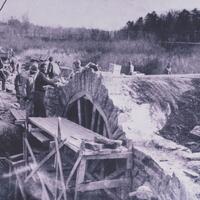
Mining was once a major industry in the Adirondacks. Iron ore was a prime resource, but there were also mines for pyrite, graphite, garnet, and talc, among others.
Scope of Collection
This collection of photographs features mines located in the Adirondack region around 1900. The images include views of Palmer Hill, Arnold Hill, Hammondville, and Clintonville.
Browse within this collection
Browse similar collections

Collection Facts
Historical Context
The vast Adirondack Mountains were one of New York State’s last untamed wilderness regions, and historical maps tell the story of how this area was explored, charted, developed and settled from the 1700s through the present day.
Scope of Collection
This selection of public-domain maps from the Adirondack Experience Library’s collection ranges in date from 1762 to 1943. Produced by both private and governmental entities, the maps document change in the Adirondack region over three centuries.
Browse within this collection
Browse similar collections


Collection Facts
Historical Context
Abby and Will Csaplar met in the 1950's on Silver Bay in Lake George and have vacationed there ever since. Their passion for the Lake led to an incredible collection of Lake George images-including stereoviews, post cards, photographs-as well as souveniers and ephemera. Lake George is located in the Champlain Valley watershed along the southeastern portion of the Adirondacks. Its natural beauty and important role in the early history of our country have made it one of the most popular vacation destinations in New York State.
Scope of Collection
This collection contains images of Lake George found in stereoviews, postcards, photographs, maps, publications, and ephemera, as well as Lake George made objects, collected over 20 years by Abby and Will Csaplar. The collection was donated in 2012.
Browse within this collection
Browse similar collections

Collection Facts
Scope of Collection
This collection consists of a mix of photographs depicting various scenes and locations in the Adirondacks dating between 1890 and 1909. Included are images of people hunting, canoeing, camping, and in costume. Also included are images of waterways and landmarks, including the Oswegatchie River and Black Lake.
Browse within this collection
Browse similar collections

Collection Facts
Historical Context
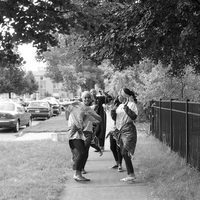
In 1980, Onondaga Community College Professor Barbara Davis set out to collect a variety of photographic and ephemeral materials that would document African-American life and history in the Syracuse area. The region was home many early abolitionists and civil rights advocates.
Established in 1918, the Dunbar Center continues to serve the historically black community in the south side of Syracuse by offering a range of programs and community services. Early in its history, the Dunbar Center served as a support center for black families migrating north to take advantage of plentiful factory jobs, and more recently the center has shifted its focus to serve its community's evolving needs.
Scope of Collection
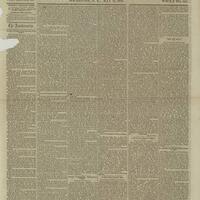
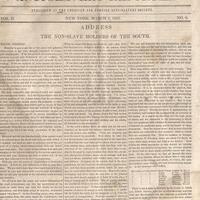
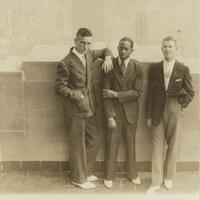
The collection includes photographs and documents relating to African Americans in the Syracuse region. The photographs depict black soldiers and local religious leaders, as well as individuals engaged in community life, sports, and social organizations, including involvement with the Dunbar Center. Ephemera from this collection includes clippings from nineteenth century newspapers and journals, as well as a handbill offering a reward for an escaped slave. The materials date from early 19th century to mid-20th century; many are undated.
Browse similar collections

Collection Facts
Historical Context
19th Century Monographs on the History of Western New York
"To one whose own neighborhood has been the theater of events prominent in the nation's annals, the history of those events is the most interesting of all history..."—History of Niagara County, N.Y., Preface
This collection includes two published books from the 19th century relating to regional history in Western New York that are held in the Library at Niagara University:
History of Niagara County, N.Y. (1878)
History of the City of Buffalo and Erie County...Volume 1, History of Erie County (1884)
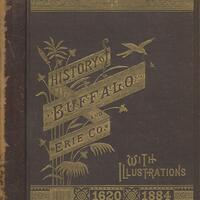
History of the City of Buffalo and Erie County...Volume 2, History of Buffalo (1884)
History of Niagara County, N.Y., with illustrations descriptive of its scenery, private residences, public buildings, fine blocks and important manufactories and portraits of old pioneers and prominent residents was published in 1878 by Sanford & Co.
This book gives the reader a sense of the struggles the pioneers had while creating farmland, the War of 1812, relations with Native American tribes, detailed descriptions of each town in Niagara County, as well as the founding of Niagara University. History of Niagara County, N.Y. is also filled with early etchings of some of the orchards and farms in the area.
History of the City of Buffalo and Erie County ; With Illustrations and Biographical Sketches of Some of its Prominent Men and Pioneers In Two Volumes. Volume 1, History of Erie County was published in 1884. Edited by H. Perry Smith, this book begins with a description of Erie County in 1620 of French and Dutch colonial settlers, Native American tribes, involvement in The Civil War (called The Union War in this book), railroad and other industrial and agricultural histories, as well as detailed descriptions of the histories of the towns in Erie County. Volume 2 of the same title begins with the time period just before the War of 1812 and covers cultural developments, banking, journalism, the first churches, the law, and medical professions. Volume 2 concludes with pictures and biographical descriptions of early pioneers. Background:
Nineteenth century local history monographs gained in popularity and production due to a number of social and economic factors. First, a series of technological advances in the book trade market and related sectors led to a rise in output of publications and a parallel decrease in costs. Second, from a social standpoint, the rising tide of immigration and the centennial celebration of the United States were contributing factors in generating increased feelings of American patriotism (and nativism). Many of the earliest county histories often mirrored genealogies of leading families in a municipality. Each of the books, as is typical in earlier local history publications, adopts a fairly chronological approach to the subject, beginning with pre-European history of the region (including geographical and topographical features, Native American settlements, and conflicts) and moving through the early exploration of New York (describing the Dutch, French, and British roles). The publications typically include detailed information on Native cultures and contact with Europeans, the period of the French and Indian War, the American Revolution, the War of 1812, the Erie Canal, the Central Railroad, and New York State in the Civil War.
In the History of Niagara County, N.Y., the author first traces the chronological events at the New York State level followed by the Niagara County level in the second part of the book. The publications also include sections with biographical information about prominent citizens (names like Fillmore, Porter, Tryon, Holley, Walden, Tupper, Wilkeson, Johnson, Hodge, and others appear) as well as additional sections that provide brief histories of cities, towns, or villages within the counties. Each of the publications includes a table of contents, index, and illustrations.
The first book, History of Niagara County, N.Y., with illustrations descriptive of its scenery, private residences, public buildings, fine blocks and important manufactories and portraits of old pioneers and prominent residents, was published by Sanford & Co. (New York, NY) in 1878.
The second book is Volume 1 of two of the History of the City of Buffalo and Erie County ; With Illustrations and Biographical Sketches of Some of its Prominent Men and Pioneers In Two Volumes, published by D. Mason & Co. (Syracuse, NY) in 1884 and edited by H. Perry Smith. The D. Mason publishing company produced several other local history titles by various authors and editors during this same time period.
Henry Perry Smith (1839-1925) was also the author of several other local history books including: History of Oakwood Cemetery (1871); A Summer Picture: And Other Verses (1879); History of Rutland County, Vermont, with illustrations and biographical information (1886); The Modern Babes in the Wood, or Summerings in the Wilderness (with E.R. Wallace, 1872); History of Essex County with illustrations and biographical sketches (1885); History of Warren County, N.Y., with illustrations and biographical sketches (1885); History of Broome County, with illustrations and biographical sketches of some of its prominent men and pioneers (1885); History of Cortland County, with illustrations and biographical sketches of some of its prominent men and pioneers (1885); Landmarks of Orleans County, New York (edited by Hon. Isaac S. Signor of Albion, N.Y., assisted by H.P. Smith and others, 1894); and Columbia County at the End of the Century, a Historical Record of its Formation and Settlement, its Resources, its Institutions, its Industries, and its People (1900).Additional Resources History of Buffalo and Erie County, 1914-1919 (Buffalo, NY: Committee of One Hundred, 1919)History of Niagara County, N.Y. (Cornell University, Internet Archive)New York State counties (county histories on Ancestry.com, rootsweb)Nineteenth-Century American Social History (bibliography by Pat Pflieger)
Scope of Collection
The collection includes monographs relating to Western New York history: History of Niagara County, N.Y. and History of the City of Buffalo and Erie County, volumes 1 and 2. The books include illustrations of notable buildings, as well as biographical sketches and portraits of prominent residents.
Browse within this collection
Browse similar collections


Collection Facts
Historical Context
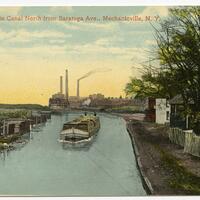
The last great rebuilding of the Erie Canal was launched in the midst of the Great Depression with backing from the Federal government. Known as the 1935 Improvement, it rebuilt locks, bridges and channel between Waterford and Oswego. While work was immediately undertaken, the Improvement was not completed until the early 1960s. It changed much of the infrastructure of the system, creating greater navigable depth and higher clearances. As part of the planning for the Improvement, an aerial survey of the Barge Canal was conducted between those two points. At the time, these orthorectified stereo images represented state-of-the-art documentation. Scales between prints were the same. The overlapping imagery allowed for stereo. They are the earliest systematic aerial imagery of the Barge Canal. While some sections of the state were so covered as early as 1927 (Buffalo), the first state-wide survey was not accomplished until 1936/38. The 1935 survey of the Barge Canal is centered on the channel and presents unmatched clarity and resolution for the time. As a work of the state, the imagery is in the public domain.
Scope of Collection
This set of photographs, created in 1935, has likely remained at the Syracuse Weighlock Building (now the Erie Canal Museum) since it was abandoned by the State in the late 1950s. The context and quality of the prints make these materials a true "Rosetta Stone" in canal research. Much of the now-gone Enlarged Erie Canal was still extant and is clearly visible. Even portions of the Clinton's Ditch and the 1793 Western Inland Lock Navigation Co. canal can be seen. So much of this historic system was lost to Thruway construction and urban growth just a few years later. Vegetation has reclaimed much over the decades, obscuring the historic channels and structures from modern views. The survey translates the locations of these 19th-century structures to a 20th-century context. This coverage includes all of the Erie Barge Canal from Waterford to Three Rivers, and all of the Oswego Canal.
Browse within this collection
Browse similar collections

Collection Facts
Historical Context
In early 1913, a severe winter storm hit the Eastern, Midwest, and Southern parts of the United States. It was the most geographically widespread natural disaster the United States had suffered up to that point in its history, and was considered worse than the 1906 San Francisco earthquake and fire by many.
Scope of Collection
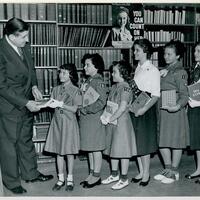
The 1913 Watervilet Flood collection is a collection of photos shows the flooding in Watervliet, New York,, along some of the main thoroughfares.
Browse within this collection
Additional Information
The local history collection contains materials on Watervliet, Troy, and selected materials on Albany County. It includes town histories and a vertical file of published materials, clippings, and other materials dealing with the Town of Watervliet. The vertical file also contains a History of Watervliet by Florence Service, 1902 (manuscript); and unpublished Watervliet histories by various authors (1980s through 1996).
Browse similar collections

Collection Facts
Historical Context
The Hudson-Fulton Celebration was held in the fall of 1909 to commemorate the 300th anniversary of the discovery of the Hudson River, as well as the 100th anniversary of the creation of the steamboat. Towns along the Hudson River held a variety of events to celebrate the region's significance in the growth and development of America.
Scope of Collection
This collection consists of postcards related to the 1909 Hudson Fulton Celebration.
Browse within this collection
Browse similar collections

Collection Facts
Historical Context
In the eighteenth and nineteenth centuries, the kitchen was not only the physical center of the household, but also the social center of the home. The hearth was used for warmth, cooking and as a place for the older generation to teach skills to the younger generation. As time progressed, newer tools were created and recipe books became more common but the hearth and the food that was made there remained at the center of life on Huguenot Street.
Scope of Collection
This collection includes recipes, images of historic cooking utensils, and receipts for home goods. Taken collectively, these items create a detailed picture of culinary practices, diet, measurement and even provision costs in the nineteenth century.
Browse Collection by:
Recipes
Artifacts
Receipts